Showing posts with label Music. Show all posts

Hip-Hop Timeline


1970  

  • The Last Poets release their eponymous debut album. It's combination of spare funk and aggressive, socially-conscious spoken word will be an early brick in the foundation of what would come to be hip-hop.

  • James Brown releases 'The Big Payback', an early funk gem that emphasizes the groove rather than melody over his aggressively spoken vocals.

  • A young immigrant from Kingston, Jamaica named Clive Campbell begins deejaying at local parties. As DJ Kool Herc, he invents a new technique of deejaying that would cut two of the same records and extend the middle instrumental, or 'break,' of the popular funk and disco songs of the day.
 Full Article

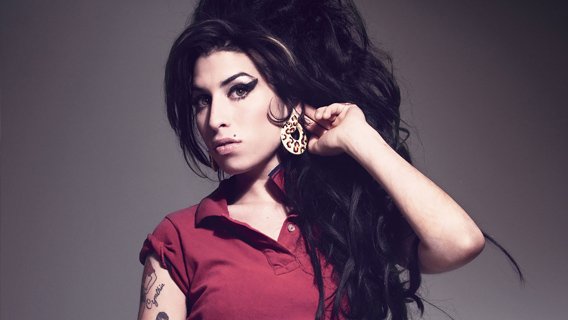
Amy Winehouse’s untimely death was a sad event yet it brought to many a sentiment of deja-vu. She is indeed one of several artists who died at the age of 27 and one of the many celebrities who lost their lives in strange circumstances. Is there more to these deaths than meets the eye?

Famous for her distinctive voice and soulful style and infamous for her controversies and substance abuse, Amy Winehouse embodied the classic dichotomy of a rock star: artistic brilliance coupled with a tendency for self-destruction. Her early death, at age 27, provided her the last ingredient required to become a memorable rock star: eternal youth. Going beyond her music, Winehouse will now be remembered as one of those who “lived fast and died young” and will forever have this mystical aura that surrounds those who have passed away during their prime. We will never see Amy Winehouse grow old and lose her edge. We will never see her become a “has been” who has to appear in crappy commercials to pay the bills. By dying at the age of 27, Amy Winehouse will forever be remembered as the fiery diva who inspired, shocked, attracted and repulsed people all at once. Most importantly, by dying at the age of 27, Amy Winehouse became the latest member of the 27 Club.

Note: This article is an observation of correlations between factual events and actuall doctrines and practices.It is by no means the author's credo nor  do I announce this as "the truth". Think for yourself.

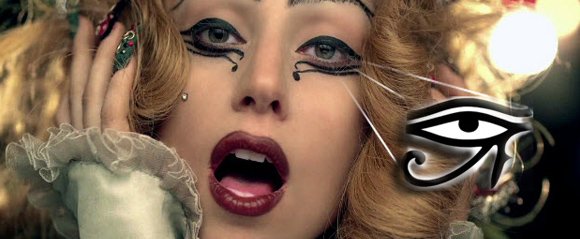
Lady Gaga’s “Judas” video is a modern retelling of biblical stories, where Jesus and his disciples are portrayed as a biker gang. But don’t mistake the video for a Bible lesson as it twists and turns important scenes to give them a very different meaning. In fact, it can be argued that the video symbolically describes an important aspect of Gaga’s work and of society in general: a rejection of Christianity in order to make way to what has been called the Age of Horus. This article will look at the origins and the symbols found in Lady Gaga’s “Judas”. It is not a statement of what is true. This article simply observes the symbolism of the video,as pertaining to certain doctrines and teachings, publicly available.

The video doesn’t only summarize the underlying spiritual message found in Gaga’s work, but it describes an important phenomenon happening in society in general – the “de-holyfication” of traditional religions.

In her recent interviews, Gaga has given several interpretations of the song. In an interview with E! Online she said that it was not meant as an attack of Christianity:
“I don’t view the video as a religious statement, I view it as social statement. I view it as a cultural statement.”
On Amp Radio Gaga explained that:
“It’s about falling in love with the wrong man over and over again.”
In another interview with Google, Gaga went deeper into the philosophical theme of the song, which is in accordance with the teachings of some occult schools we’ll describe later.
“The song is about honoring your darkness in order to bring yourself into the light. You have to look into what’s haunting you and need to learn to forgive yourself in order to move on.”
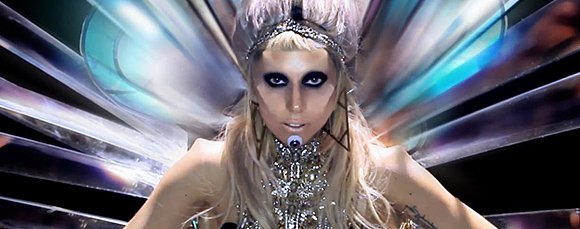
The videos for Gaga’s songs Alejandro and Born This Way communicated specific spiritual messages through meanings and symbols. Traditional religious symbols are stripped of their “holy aura” while other symbols, inspired by those of the Illuminati, are introduced and glorified to her young viewers. Of course, this phenomenon does not happen only in Gaga’s works, but is a trend in mass media in general. Aleister Crowley, an occultist who remains an incredibly influential figure in the entertainment industry, claimed the Age of Horus, a new stage in human history, would be defined by the abandonment of traditional religions in order to embrace a new kind of spirituality. The same vision for a “new Aeon” is shared by the world elite, where its plans for a New World Order heavily rely on the existence of a single world religion, based on a specific set of values that are compatible with is Agenda. Mass media plays an important role in this paradigm shift – and the results are astonishing. In less than a century, the Western World has witnessed a drastic decline in religious faith, especially Christian. Never such a profound societal change happened in such a short period of time. Of course, Gaga herself is not responsible for this drastic shift, but Judas, in its meaning and symbolism, perfectly describes the transitional period we are going through, as society is taken to, in Crowley’s words, the Age of Horus.

It is therefore in this social and religious context that Judas was released. First seen riding with Jesus, Gaga goes into a transition and falls for Judas, the man who ultimately caused the death of Jesus. Gaga’s conversion is symbolic of society in general, where the altruistic tenets of Christianity have been replaced by a more “self-celebrating” philosophy – embodied in the video by the character of Judas. In short, the story symbolizes the passage towards Crowley’s Age of Horus, and Gaga’s “Eye of Horus” makeup effectively seems to emphasize this point. As seen in previous articles, Gaga is no stranger to Crowley’ philosophy (her Manifesto at the beginning of Born This Way is heavily inspired by his Thelema). This philosophy is, in turn, the basis of the new kind of spirituality that is sold to the masses through media.

To explain Judas, I need to “get Biblical” because the song and the video are heavily inspired by Biblical verses. So, before we get into it, let’s start by understanding the main character: Judas.

Lady Gaga’s single “Born This Way” introduces the viewers to the birth of a “new race” and to a new world, using intricate imagery and a precise narrative. It is a psychedelic trip filled with occult and archetypal symbols, telling the story of a cosmic birth and new ideals. However, behind its outward message of acceptance, a more sinister message lies embedded in the symbolism of the video. We will look at the underlying meaning of “Born This Way” and analyze the meaning of the occult symbolism in the video.
Lady Gaga is back, y’all.  And she’s got horns on her forehead. And she’s in space. And she’s making 90′s dance music. And my head just exploded. But seriously, Born this Way seems to provoke in people two opposite reactions, depending on their knowledge of occult symbolism. It is either “What the heck just happened here?” or “This is really blatant”.  The reason is simple. The video contains new strange elements that might confuse viewers but it also contains symbolism that is extremely ancient. Although the video is set in a futuristic, intergalactic world, it deals with the most primal concept of humanity: motherhood. It plays on human’s archetypal fascination and/or repulsion towards the act of giving birth.

Although the lyrics of Born This Way are about unconditional acceptance, with a special focus on homosexuality, the video’s scope goes way beyond the subject of sexual orientation. It narrates the birth of a new race within humanity. Laurieann Gibson, the creative director of the video describes this concept:
“At first, when I thought about birthing a new race and adding the prosthetics, I thought that maybe they should have a certain way they should walk or maybe they move a certain way, but then I realized it is actually a race within our race; it’s a mindset.”
- Source
Gaga is not giving birth to a human but to a “new race” within humanity. The symbolism of the video makes it clear that this birth is not natural, but artificially provoked. A twisted immaculate conception. As is the case for most Lady Gaga videos, the theme of mind control is important in the video. It is the process through which the metamorphosis will take place.  In Monarch programming terms, we are witnessing the birth of a new persona within the “core personality” of humanity. The birth is happening within the minds of people and is visually represented by creepy facial horns.Furthermore, the esoteric imagery in the video describes a world change that is occurring as an alchemical process: The creation of magic through the unification of opposing forces portrayed through the use of archetypal symbols and messages. Yup, we’re still talking about a Lady Gaga video.


http://www.weallwantsomeone.org/wp-content/uploads/2010/10/Kanye_West_My_Beautiful_Dark_Twisted_Fantasy_album_cover.png

In the opening bars of My Beautiful Dark Twisted Fantasy, Kanye West asserts, “We found bravery in my bravado.” As far as Hip Hop music goes, this is too true. Because of West’s renaissance of carefully-crafted artistry and decadent decision-making, Rap has been restored from an over-saturated commodity to the grandiose stage Jay-Z left empty after The Black Album.

The earliest glimpse at My Beautiful Dark Twisted Fantasy is one of its best moments. "Power" is the Kanye West that will be most remembered in lyrical circles. “In this white man’s world, we the ones chosen / So goodnight cruel world, I’ll see you in the mornin’ / Huh? I’ll see you in the mornin’ / This is way too much, I need a moment.” Just as Eminem paused amidst his uber-fame in 2002 to relive his battle-to-mainstream ascent in “Till I Collapse” and “Lose Yourself,” Kanye West reminds us that while he’s reading price-tags and royalty statements, he still reads the news. he declares on "Gorgeous", “Face it, Jerome get more time than Brandon / And at the airport, they check all through my bag and tell me it’s random / But we stay winnin’ / This week has been a bad massage, I need a happy endin’ / And a new beginning / And a new fitted / And some job opportunities that’s lucrative / This the real world, homie, school finished / They done stole your dreams, you don’t know who did it / I treat the cash like the government treats AIDS, I won’t be satisfied till all my niggas get it, get it?” At a time when West is revising a blueprint he’s help create for Drake and Kid Cudi, his sharp, outspoken lines put him in the lineage of Ice Cube and Chuck D, something that ‘Ye’s predecessors cannot seem to do - without him as a link. Lines like that complement Rap laureate Gil Scott-Heron on West’s closer, “Who Will Survive In America?” And for every mention of Oscar De La Renta, Lamborghini and private jets, one of Hip Hop’s wealthy elite still finds a way to make recession-applicable music without kneeling.

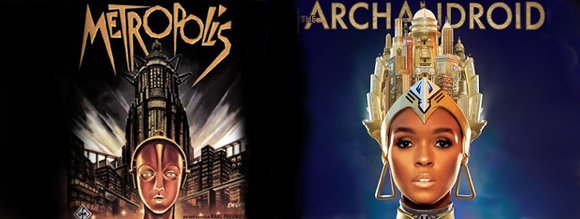
Fritz Lang’s 1927 movie “Metropolis” is one of those timeless classics that withstand the test of time. Rather than becoming forgotten and obsolete, “Metropolis” is increasingly relevant as many of its predictions are becoming reality. We will look at the  underlying occult message of the film and the usage of its imagery in the acts of  pop stars such as Lady Gaga, Madonna, Beyonce, Kylie Minogue and others.
Wake Up Review

Before Wake Up!, I wasn’t quite sure where I stood with John Legend. His debut found him miscast as a unique type of badboy, gospel-drenched vocals jumping from one girl to the next in an attempt to blur the lines between the then-sputtering neo soul movement and the direction of more mainstream R&B artists like Usher. It left an awfully confused taste in my mouth, as does the arc of his career. Evolver, his most recent album, was another cluster of half-baked attempts at crossover and experimentation. While it sounded remarkably different from Get Lifted, over four years it seemed little had changed with Legend as an artist.

But then I heard the sample of “Again”—appearing on Legend’s Once Again LP that I’d skipped over—on the Roots’ offering earlier this year (How I Got Over) and after listening to that album, I was thrown for a loop. Here, Legend’s voice had risen far beyond merely good to occasionally fantastic, and all but one or two tracks were not just tolerable, they were superb. This discovery occurred just a few weeks ago, around the same time I got my first glimpse at what Legend and the Roots have been collaborating on since Evolver limped into the masses: Wake Up!.

Originally intended as a one off charity benefit type project, the combination quickly grew into an LP that, besides a few minor hiccups, makes a strong case for the collaboration continuing into the future. While all but two tracks here are covers, ?uestlove and James Poyser has done such an excellent job of arranging both the tracklist and the songs themselves that only the most well-versed poli-soul listeners will pick out the originals. The opening one-two punch of “Hard Times” and “Compared to What?” are particularly incendiary, and that hard Stax kind of funk appears once again on “Our Generation”.

The common thread throughout the entire project is revolution and political activism, something the extensive liner notes make blatantly clear. But the song selection is superb enough that the LP works perfectly fine as a straight up funk and soul record. In less capable hands things could get a bit awry, but not only does this band play tight as hell, they each find their moments to showcase individual talents. Legend goes from channeling Eugene McDaniel’s raging, deep soul on “Compared to What?” to harnessing a heretofore seldom heard higher register for the aforementioned reggae jam. Captain Kirk delivers a righteously funky guitar riff for “Hard Times” that adds an extra hundred degrees to the song, and each time Black Thought appears will stir familiar feelings from the Roots’ last few LPs that there is simply not enough of him here.

Owen Biddle, ?uestlove and James Poyser play more complimentary roles on the album, though all three are the spine around which the longer jams—12-minute protest song “I Can’t Write Left Handed” and seven-minute self-empowerment jam “Hang on in There”—unwaveringly cling. The way the band flits between these different motifs and feature players is entertaining, but it’s honestly John Legend that takes the most away from this release. He not only delivers his most focused effort yet, but his most diverse. The way he sings on “Hang on in There” and “Humanity” is just a joy to listen to. The band closes the album with “Shine”, the one Legend-penned original song on the album (Malik Yusef also provides an original spoken word intro to Little Ghetto Boy), and passes their final test by cranking out a song much less mundane than Legend’s previous attempt at world-unifying, “If You’re Out There”.

While it’s simplicity is greatly noticeable alongside these masterworks of soul, “Shine” also feels as fitting a finale to Wake Up! as anything else could be. Again, this is a testament not only to the quality of the musicians or the songs they play, but the way they’ve strung them together like something of a live, in studio performance. This spirit is, above all else, what makes Wake Up! such a success. There is no pretense that this band will equal the songs they’re reviving, though through seemingly unlimited talent they often come as close as possible. Wake Up! is an album explicitly from the heart, worn on its sleeve in a way few artists with such mainstream attention seem willing to match. What could have come off as a mediocre-to-good novelty project has, instead reaches the public coming just short of being a genuine contender for album of the year.


John Legend ft. The Roots - Wake Up Everybody

By Outspoken Poet
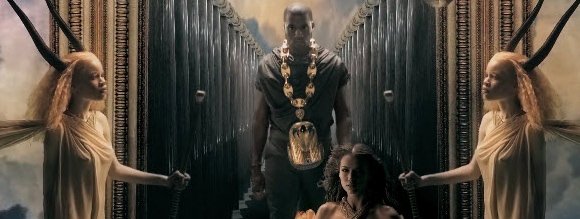
Kanye West’s “Power” is a short, almost stationary video that manages to tell a profound story in symbolic language. By decoding the occult meaning of the symbols present in this moving tableau, the viewer discovers who really holds the “power” in the world and understands the story of Kanye West’s initiation. We will look at the meaning of those symbols as they appear in the video.

Rapper and producer Kanye West has always found a way to stand out from the crowd. His video Power is no exception. It differs from the MTV norm in many regards, whether you look at the content or the form. The duration of the video, the filming style and the subject matter are quite distinct from today’s typical rap videos as it is short (1:43), filmed in a single shot (compared to the one-shot-per-second standard of music videos) and is very rich in archetypal symbolism.

Director Marco Brambilla sought to depict the concept of power in the form of a “video tableau”, a moving painting that slowly reveals itself to the viewer with a continuous camera movement. The director seem to have perfected this technique in his previous creation, Civilization, a video mural created for the new Standard Hotel in New-York city. The symbolism present there is simply overwhelming. Here it is:


For Power, Brambilla went for a neo-classic aesthetic, but still created a piece full of symbolic and cultural references. As it was the case for paintings of the neo-classic era, each object, each symbol and each detail in the video conveys an important meaning, a meaning that is needed to understand the entire story. As we will see later, many symbols in the video have a deep occult meaning and many of them point to Freemasonry and Mystery schools. By doing so, the director clearly states what type of power is being presented in the video. We will therefore look at the meaning of the symbols displayed in the video as they appear in the shot. If you haven’t seen it, here it is:


Symbols Of The Video

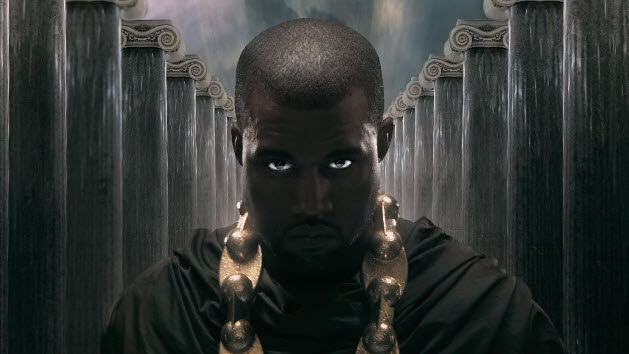
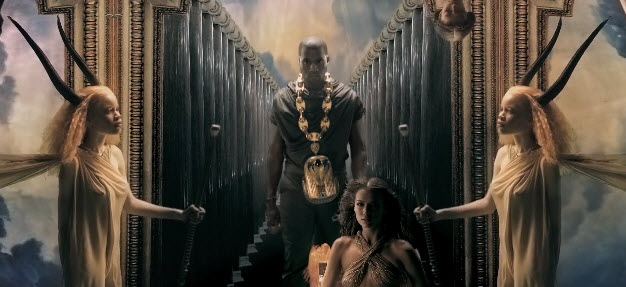
The video starts off with a close-up of Kanye West with glow-in-the-dark eyes, as if he was “illuminated” from within or to hint at a demonic element. He stands between an infinite row of Ionic columns, which represent “wisdom” in Masonic symbolism.


Two Pillars

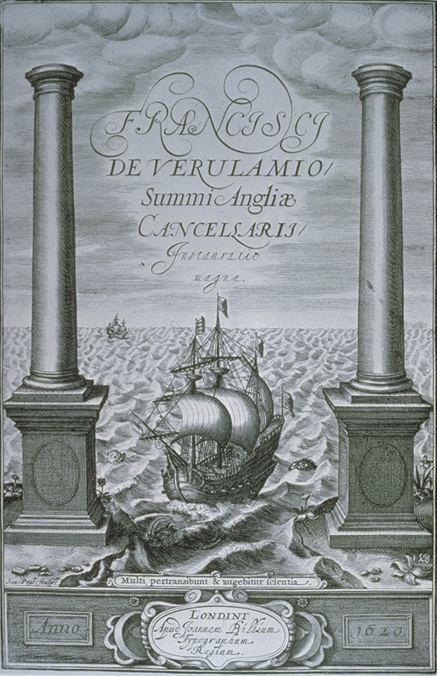
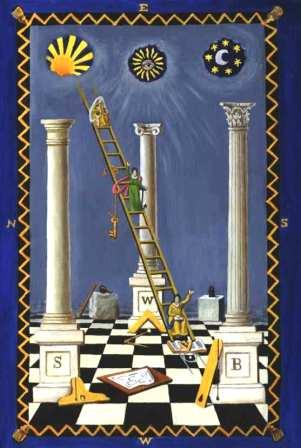
As regular readers of this series already know, the occult meaning of the twin pillars is ancient, profound and presented in the symbolism of almost all mystery schools of History. There are many layers of interpretation attributed to the two columns, but one constant is always present: The pillars represent the entrance – the gateway – to the world of the initiate. Behind the columns can be found the key to the Mysteries and, consequently, the source of true power. This concept has been used for in many cultures and schools of thought.


The two columns called the “Pillars of Hercules” in Ancient Greece stood at the gateway to the sphere of the enlightened
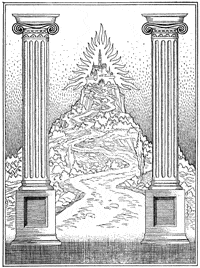
“The city of the philosophic elect rises from the highest mountain peak of the earth, and here the gods of the wise dwell together in everlasting felicity. In the foreground are the symbolic pillars of Hercules which appear on the title page of Bacon’s Novum Organum, and between them runs the path which leads upward from the uncertainties of earth to that perfect order which is established in the sphere of the enlightened. “
- Manly P. Hall


Pillars of Hercules in Francis Bacon’s “New Atlantis” as a gateway to the New World

Two pillars leading to Jacob’s Ladder in this Masonic tracing board

Masonic initiate standing between the twin pillars as the third pillar, in the same fashion as Kanye West in the video.
In Power, Kanye is standing at the mouth of the gateway to the “sphere of the enlightened,” right at the border of the corrupt and decadent material world. So, right from the start of the video, the director reveals his take on the true nature of power in this world: It is not your democratically elected officials, but those who consider themselves to be behind those pillars. One of the most significant lines of the song is

“In this white man’s world, we the ones chosen”

Does Kanye’s “white man’s world” refer to the hidden rulers, the Illuminati, who are hidden behind those pillars or to the ongoing oppression and prejudice against colored people? 

Horus


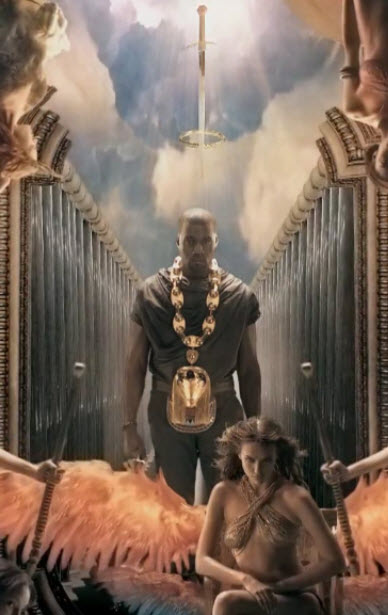
Horus pendant on Kanye’s chain
The next thing that catches the viewer’s eye is most probably that gigantic chain with Horus’ head as a pendant. Horus is an ancient Egyptian deity that has an extreme importance in occult mysteries. Considered to be the Sky god, he is more often represented with the symbol of a single eye.  The Eye of Horus is an ancient Egyptian symbol of protection and royal power from deities, in this case from Horus or Ra.
“Horus, the son of Osiris and Isis, was called “Horus who rules with two eyes.” His right eye was white representing the sun while his left eye was black representing the moon. According to Egyptian legend Horus lost his left eye during a fight with his murderous uncle, Seth, to revenged his father’s death. Seth tore out his nephew’s eye but lost the fight because the assembly of the gods declared Horus the victor. The eye was reassembled by the magic of Thoth. Then Horus gave the eye to Osiris who experienced rebirth in the underworld.”
- Jordan Michael, Encyclopedia of Gods


Horus, god of the sky


The Eye of Horus as depicted by the Golden Dawn Mystery School
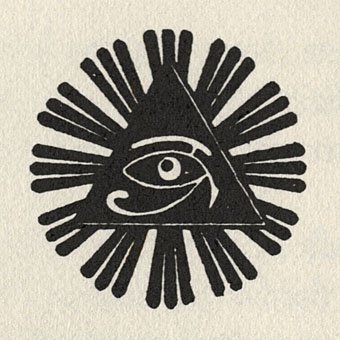
The symbolism of Horus is especially of great importance in Freemasonry, as the path of an initiate through the Masonic degrees is described as the process by which the Eye of Horus is opened.So Kanye stands at the gateway between the corrupt world of the profane and the exclusive world of the illuminated, wearing a Horus pendant, an unmistakable symbol. One might say: “Well maybe Kanye just likes Egyptian things.” Maybe so, but in the context of this video, where all details are important and extremely meaningful, Horus becomes another piece of this symbolic puzzle.

Horned Girls

The entrance of the gateway of pillars is guarded by two horned albino girls holding a staff. Their features are very reminiscent of depictions of Isis and Hathor, goddesses of ancient Egypt. Another allusion to Egyptian magic.


Kanye standing between two horned female figures

Isis and Hathor crowning Queen Nefertari. Both goddesses were depicted with bovine horns on their heads.
Isis was the mother of Horus (discussed above) and was the goddess of motherhood, nature and magic. Hathor was also considered as a maternal deity while also being the goddess of music, dance and fertility. Both Isis and Hathor were known to welcome and protect the dead during their journey to the afterlife, a concept that is particularly interesting in the context of the video.


Hathor holding a sceptre with Pharaoh Ramses II
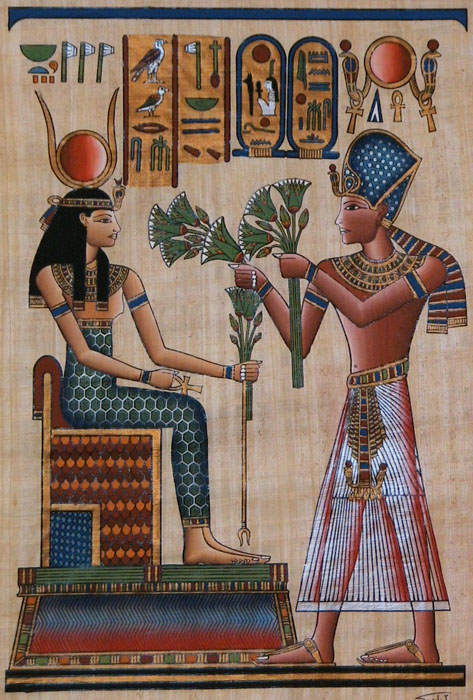
“The goddess (Hathor) [...] manifests two aspects of her divine power: first of all, she participates in the afterlife rite of passage, by means of which the deceased attains eternal life, and, second, she demonstrates her special connection to the Egyptian king. Hathor is rightly called a royal goddess, and in this role she is linked in various ways to the life of the pharaoh. Often the pharaoh would call himself the oldest son of Hathor.”
-  Archive for Research in Archetypal Symbolism
Kanye, perhaps symbolizing the Pharaoh, is standing at the gateway to eternal wisdom, about to be executed/assassinated/sacrificed under the watchful eyes of Hathor, the “royal goddess.” Are the goddesses welcoming Kanye “behind the veil,” protecting him in this rite of passage to immortality? In occult circles, new candidates must symbolically die and be reborn to complete their initiation process. Is Kanye being killed an allegory for his initiation?

Sword of Damocles


Sword hanging above Kanye West’s head
While doing some preliminary research on this video, I came across an article on MTV.com titled Kanye West’s ‘Power’ Video: A Cultural Cheat Sheet. Here’s what it says about the sword hanging above his head:
“Dragonlance: An image of a sword descending into a crown hovers over Kanye’s head, bringing to mind Volume Two of Douglas Niles’ series “The Crown and the Sword: The Rise of Solamnia,” in which Sir Jaymes Markham commands the orders of the Rose, Sword and Crown.”
- Kanye West’s ‘Power’ Video: A Cultural Cheat Sheet, MTV.com
Really? The director of this neo-classical themed video, was inspired by an obscure fantasy novel released in, like, 2006? Seriously? Good job, MTV, in keeping our youth clueless. The descending sword is more probably a reference to the Sword of Damocles, a pretty widely known legend, though one might argue it to be any other legendary or ordinary sword.


Wenceslas Hollar’s depiction of the Sword of Damocles
“The Damocles of the anecdote was an obsequious courtier in the court of Dionysius II of Syracuse, a fourth century BC tyrant of Syracuse. Damocles exclaimed that, as a great man of power and authority, Dionysius was truly fortunate. Dionysius offered to switch places with him for a day, so he could taste first hand that fortune. In the evening a banquet was held where Damocles very much enjoyed being waited upon like a king. Only at the end of the meal did he look up and notice a sharpened sword hanging directly above his head by a single horse-hair. Immediately, he lost all taste for the fine foods and beautiful girls and asked leave of the tyrant, saying he no longer wanted to be so fortunate.
Dionysius had successfully conveyed a sense of the constant fear in which the great man lives. Cicero uses this story as the last in a series of contrasting examples for reaching the conclusion he had been moving towards in this fifth Disputation, in which the theme is that virtue is sufficient for living a happy life. Cicero asks “Does not Dionysius seem to have made it sufficiently clear that there can be nothing happy for the person over whom some fear always looms?”
- Source
The tale of the Sword epitomizes the constant danger faced by those in positions of power. Kanye stands there, in a state of  impending doom, knowing he can be executed at any time. Right after we see the sword of Damocles, a figure appears holding a dagger and attempting to stab him. The assassination will not happen by dagger, however, as two other figures leap out of nowhere holding swords to accomplish the “Killing of the King.”

Killing of The King - The Initiation


Ritual initiation represented in a display of geometry and symmetry
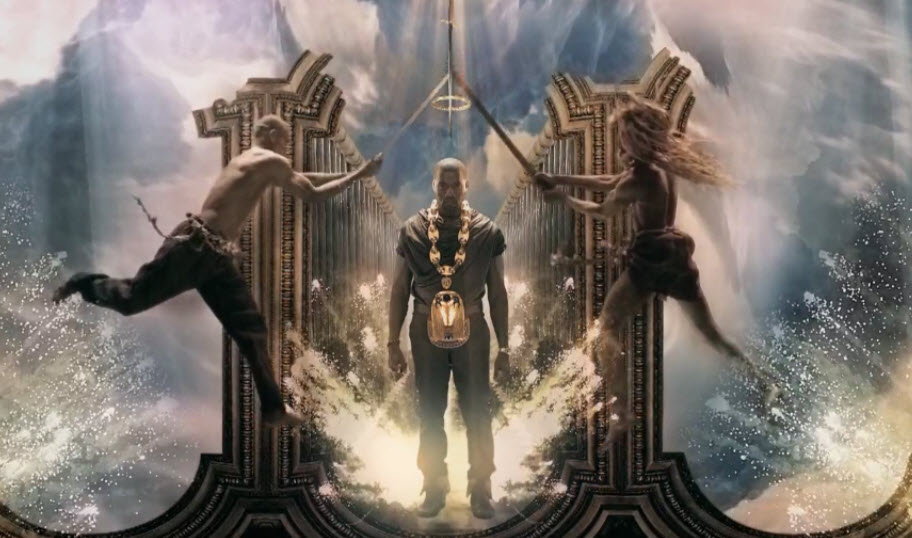
At the ending of the video,  the decadent women and the dagger-holding assassins all disappear as two swords are about to hit him. Are we sacrificing the King?
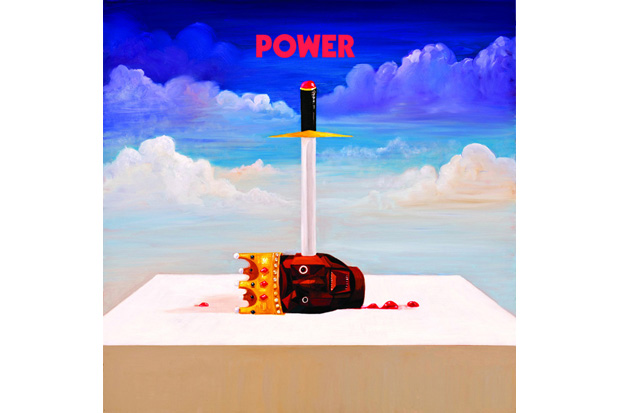
The concept of regicide is reflected in the single’s cover art. It depicts Kanye’s severed, crowned head with a sword firmly jammed into it. Apparently Kanye was king and he got killed. Is this a symbol for a Masonic ritual? Note the stone on which Kanye’s head is placed. Is it the “perfect ashlar” of the Masons that represents the state of a perfected initiate?


Covert art of Power portraying the killing of Kanye West as a king.

A perfect ashlar in a Masonic lodge. In Masonic symbolism, the candidates start their journeys as allegorical “rough ashlars” and, through knowledge and wisdom, smooth out their edges in order to become a perfect ashlar.

Some occult researchers have stated that the “Killing of the King” is the name of a Masonic rite of passage to obtain the 33rd degree (see “King Kill 33″ by James Shelby Downard & Michael A. Hoffman II). Semi-interesting sidenote: King Kill 33 is also the name of a Marilyn Mason song, with rather interesting lyrics. Another sidenote: Researchers have reported that  Killing of the King rites often happens in public, as more witnesses give more power to the ritual, hence … JFK. A completely crazy theory?… DYR (Do your research).
Back to Kanye and his standing … the two swords flying towards him never actually touch him but instead form a triangular shape above his head, possibly hinting to a “symbolic” killing and not an actual one. Notice the position of the crown above Kanye’s head. The combination of those elements form an interesting image.


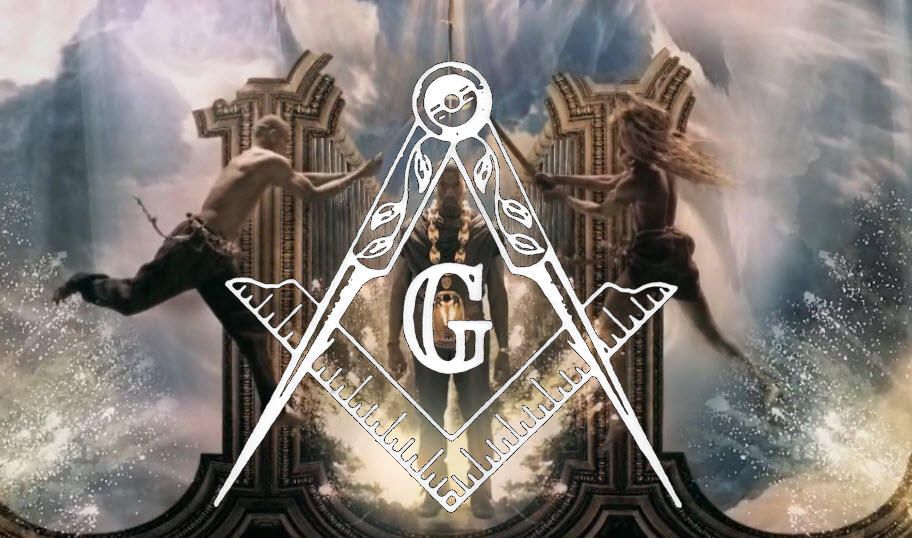
Masonic Square and Compass
 
In Conclusion
To sum up the the video, Kanye stands at the border between Masonic knowledge and the decadence of the mundane life, represented by lustful and gluttonous women, lounging around eating grapes. Kanye says “goodbye cruel world / I see you in the morning“, as he has been “chosen” to take part in an initiation process that is often metaphorically described as a “long night,” followed by a glorious awakening as a new being. In order to accomplish this, Kanye needs to kill his old self and be ritualistically reborn. Once this is done, true power is within his grasp.This “moving painting” is definitely a multi-layered artwork, with many levels of interpretation: the first level is a commentary on power by using timeless symbols taken from ancient art; the second level describes a Masonic initiation with a ritual murder and an imminent rebirth.

This video lasts a mere minute and forty-three seconds but it manages to give the viewers plenty to ponder on and many symbols to decode. Looking at its meaning from a pop culture point of view, it is interesting to note that this short-film, intended to be viewed by the general public (especially young people), describes the concept of power with overt Masonic symbolism and occult references. This causes the uninformed viewers to unconsciously associate those symbols with the concept of Power, while “those in the know” get the “insider’s wink” sent by this video. Power ultimately becomes another piece in the on-going process called the “Revelation of the Method,” where the true source of power gradually and subliminally reveals itself to the world and occult rituals take place right in front of the public’s eyes, accepted by pre-implanted psychological facilitators.

I'm not saying that this is what it is represented to be here.Kanye might just have read a few books on masonry and then decided to make it fashionable ;)
“The clock’s tickin’ / I just count the hours”


An exert from John Potash's book 'The FBI War on Tupac Shakur and Black Leaders"Note:The book follows mainly 2pac but also the black panters as his mother and surrogate father were high-ranking members.Evidence has now proven the intervention of the FBI in their pursuit and incarciration.

 http://incilin.files.wordpress.com/2009/06/2pac-tupac.jpg

Fame and Politics

By the end of the Reagan/Bush era, Shakur's auspicious musical debut, including lyrics discussing his Black Panther family, coupled with leading movie roles, threatened to bring the Panthers back into vogue.

Thus it is no coincidence that Shakur attracted police attention in direct proportion to his fame and success. In line with Shakur's quote, "I never had a record until I made a record," shortly after his successful solo debut, Oakland police ticketed him for jaywalking, then arrested and beat him in custody.Shakur's first record, 2Pacalypse Now, railed against the FBI, the CIA, and President Bush. In 1992, a year after that album's release, Vice President Dan Quayle, and later Senator Bob Dole, singled him out as responsible for police deaths.

With the FBI watching Shakur since he was a teen, and his leadership in the New Afrikan Panthers, a group dedicated to replicating the Black Panthers,police involvement in his life deserves more scrutiny.

While Shakur's lyrics often dramatized inner-city life, including what some might view as negative images, glorifying gang life and denigrating women, they also included many positive political messages: ideas about Malcolm X and various Black Panthers.As a youth, Shakur performed benefits for Black Panther prisoners. By nineteen, he sang with the Grammy-nominated band Digital Underground. Besides his stint as a Panther Chairman and his Underground Railroad/Thug Life Movement, Shakur participated in a Stop the Violence program, helped with a home for at-risk youth, sponsored a "Celebrity Youth League," joined Central American solidarity benefits, and regularly spoke at rallies for voter registration and progressive activist groups.

The nature of the beneficiaries of Shakur's ever-increasing success must have set off alarms in the intelligence world. Some of Shakur's enormous wealth (the estimated worth of his 200 unreleased recordings alone was over $100 million) was donated to programs and causes his Panther family supported, including Afeni Shakur's research efforts, with her imprisoned partner Mutulu, which eventually contributed to the release of Pratt in 1997.

Shakur was also achieving a new-found maturity in his mid-twenties. His engagement to Kidada Jones, daughter of music mogul and Vibe magazine owner, jazz composer Quincy Jones must have worried police and intelligence officials, because of the vast wealth and influence of the elder Jones, and concern that Shakur's activist projects, such as his "Thug Life Movement" to turn drug dealers into lawful singers,and his last interview statements of going back to his family's ways, would mark a return to his earlier radical activism.

The Setup

The finding of continued COINTELPRO-type activities adds weight to evidence that Shakur's associate Jacques Agnant (a/k/a Ricardo Brown, a/k/a Nigel) was an undercover agent who infiltrated his life and contributed to his legal problems. In 1993, after befriending Shakur, Agnant introduced Shakur to Ayanna Jackson the night she had consensual sex with the singer, first on a dance floor and then in his hotel room.In a second visit to Shakur's hotel room several days later, set up again by Agnant, Jackson charged Shakur, Agnant, and two others with sexual assault.

Events around the trial point to Agnant's government connections. Agnant's trial lawyer, Paul Brenner, had represented the Policemen's Benevolent Association for many years.In addition, Agnant's case was severed from that of the other defendants without protest from the prosecutors. And, after Shakur's trial, Agnant's felony indictment was dismissed, and he simply pleaded guilty to two misdemeanors.

Shakur was convicted of three of the nine charges, relating only to non-consensual touching of Jackson's buttocks (typically reported only as "sexual abuse"), and sentenced to one-and-a-half to four-and-a-half years, an extremely harsh sentence.(In 1994, New York City police admitted "accidentally erasing" a tape Shakur and companions had of Jackson that supported Shakur's defense. His lawyer, Michael Warren, successfully argued that the police also planted guns in the hotel suite where the supposed assault occurred.

Jacques Agnant was also connected to Shakur's near-fatal mugging in late November 1994. Toward the end of Shakur's sexual assault trial, Agnant was seen several times secretly following Shakur. Several days later, "Booker," a man Agnant had introduced to Shakur, paged the singer and asked him come to a studio in Times Square to record with a new rapper. Booker called Shakur insistently that night, lied to him about who would be there, and offered $7,000 cash from his pocket to get Shakur to the building. When Shakur arrived with three companions, two men held him at gunpoint in the lobby and stripped him of his gold jewelry, although they left his diamond-encrusted Rolex, which Agnant had bought for him. Then they shot him in the groin and twice in the head, while he was face-down on the floor.

Los Angeles

Some suspicious aspects of the event were noted by editors of the Amsterdam News.Shakur and a companion both said they saw a police car outside the lobby doors on Broadway, immediately after the assailants fled, guns in hand. The New York Police reported this as a random mugging, yet the assailants picked an extremely well-lit Times Square area for a robbery.

In what the Washington Post described as "one of the many strange twists in the case,"three of the same cops who first appeared a year earlier at Tupac's hotel in the sexual assault arrest were the first to arrive at this near-fatal "mugging."And at least one has been identified as a member of New York's now infamous Street Crime Unit.

A History of Provocations

There are many examples of police and intelligence provocations against Panthers, including infiltrators, fake letters, fabricated rivalries, etc.

After Shakur's imprisonment for the sexual abuse conviction, jailmate "informants" and anonymous letters he received led the singer to believe that his fellow rapper friend Biggie Smalls (a/k/a Christopher Wallace) had set up the shooting, even though Smalls lacked a motive for doing so.

Biggie Smalls was killed in Los Angeles in 1997, seven months after Shakur's murder. The L.A. Times reported that New York police officers were near the murder scene when it occurred, supposedly taking part in a federal investigation into Smalls's record label.His death helped "substantiate" the East/West rap war that the authorities were trying to foster, and directed suspicions toward Brooklyn-based Smalls for California-based Shakur's death.

Political writer Christian Parenti suggests that the East/West rap music feud, as well as Shakur's sexual assault charge, may have been a latter-day COINTELPRO against rap artists.

A Desperate Agreement

After rejecting two previous offers from Death Row Records owner/producer Marion "Suge" Knight, an imprisoned Tupac Shakur was finally forced to sign a contract that included his bail money. But people close to Shakur knew he wanted to leave Death Row and start his own label. Ten days before his murder, Shakur fired Death Row lawyer Dave Kenner, who had been assigned to him by Knight. Friends of Shakur reported that this move was very dangerous because of Kenner's power in Death Row Records and Knight's violent business practices.

LAPD intelligence operations suggest Knight's connection to a government program.Los Angeles was the site of the largest western FBI/police intelligence collaboration against Black activists in the 1960s and 1970s, as described above in the targeting of Geronimo Pratt. L.A. was also the site of the CIA-Contra connection to crack cocaine in the 1980s, and there is evidence that Knight was involved in drug dealing at that time.Crack cocaine infiltrated into South Central L.A., created millionaires, some of whom worked with the authorities, particularly the notorious government collaborator "Freeway" Ricky Ross.

One of L.A.'s two top cocaine dealers who came on the scene at the same time as Ross and reportedly "ended up buying from him... and... learning from him," was Michael Harris.Harris, who ended up in jail, was represented by David Kenner, who convinced him to put up the first million dollars to start Death Row Records. Kenner made himself president of Death Row Records and later completely cut Harris out of the company. Harris is currently suing Kenner.

Suge's Role

It was Suge Knight who was driving the car in Las Vegas the night of Tupac's murder. Kidada Jones, Tupac's fiancée, reported that Tupac wanted to drive his own car that night, but Knight convinced the rapper to ride with him in an open-windowed BMW. According to an ex-bodyguard of Knight's, the murder scene was "aberrant" because there were no armed bodyguards in Knight's car nor in the accompanying car behind them. Although Knight had lived in Las Vegas for several years, and knew the area well, he made a curious U-turn away from a nearby hospital as Shakur lay dying next to him. Weeks later, Knight stated that he wouldn't give anyone information about the killers because "it's not my job." Knight was arrested and jailed for violating his probation a few days after Shakur's death. He has continued to run Death Row Records from his jail cell. (In early April, Knight was named as a suspect in Biggie Smalls's murder, which the authorities claim he masterminded from jail.)

After Tupac's death, Afeni Shakur was told that her son owed Death Row money, even though his albums for the company had grossed over $150 million in sales (70 percent of rap albums are bought by white youth) . While Afeni won the legal right to obtain all of her son's unreleased recordings, she only received a portion of them from Death Row. And their more than $100 million estimated dollar value would soon decrease. With very little financial motive for the only suspect, Death Row, government pressure probably led Knight to let 13 illegal bootleg discs hit the streets and massively devalue Afeni Shakur's inherited estate.

Tupac's Legacy
In his last interviews, Shakur espoused radical political ideas and plans. He spoke of religion as social control, of returning to his family's ways but "with a more militant philosophy," of plans to start an interracial "lost-tribe" political party, and to devote future album proceeds to start community centers. He also explained that his trademark "W" hand sign, which had indicated the West Coast, would now mean "War." He said, "West Coast and East Coast together [to gain] power" for "Black America."

Shakur's incredible fan devotion and societal influence were likely thorns in the side of the intelligence community. After his death, Shakur received tributes by leading intellectuals and was memorialized in mass assemblies at Black colleges. His legacy sparked courses devoted to his work at prestigious universities, including the University of California at Berkeley.

While unsubstantiated versions of the story behind Tupac Shakur's death are frequently asserted, there has been no real independent investigation of government involvement. Shakur's political-activist life and radical heritage call for such an inquiry.
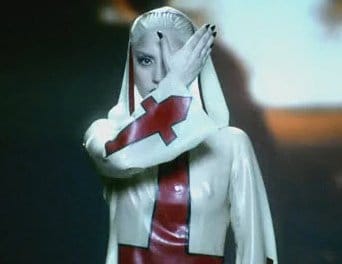

Lady Gaga’s Alejandro video caused quite a stir with the blasphemous nature of its imagery. Many people are, however, still wondering: What is the meaning of the song and what message is the video trying to convey? This article examines the occult symbols used in Alejandro in order to understand its underlying message.

So, by show of hands, who envisioned gay Nazi soldiers being raped by Lady Gaga while first listening to Alejandro? Okay, counting … one person. One sick, disturbed person. But seriously, art doesn’t have to be literal and Lady Gaga’s latest video surely isn’t. As was the case with Bad Romance and Telephone, the video for Alejandro adds another layer of interpretation to the song by giving the words a deeper meaning.

Taking place in a cold, Orwellian, militaristic setting, the visuals of the video sharply contrast with the “summer-y” Latin beat of the song. Other opposing concepts collide and blend in the video as well: good vs. evil, male vs. female and domination vs. submission. The religious symbolism, in addition to adding the “shock factor” necessary to get people talking, gives the song a definite spiritual connotation.
The video for Alejandro is very symbolic and leaves it open for multiple interpretations. For instance, I’ve read an interpretation of the video claiming that it portrays the Catholic church’s repression of the gay community. This interpretation might have some validity to it, but it ignores many important aspects of the video. Other observers seem to believe that all videos with religious imagery are “tributes to Madonna.” Yes, Madonna did Like a Prayer, but this doesn’t explain anything in Gaga’s video. In addition to a possible tribute, the symbolism of the video tells a story of spiritual rejection and metamorphosis taking place in the context of an oppressive police state.
We will attempt to decode the symbolism of the video and how it relates in today’s context. 

Here’s the video:

Spiritual Transformation

The most prevalent theme in the song is rejection. The introduction of the song establishes this concept right away:
“I know that we are young.
And I know you may love me.
But I just can’t be with you like this anymore,
Alejandro.”


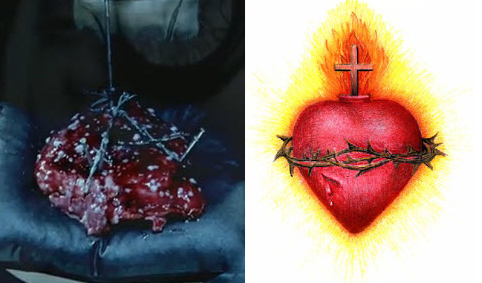
The video starts with a funeral procession. Gaga wears a black veil and holds the Sacred Heart, the bleeding heart of God for humanity. Something is dead inside of Gaga and it seems to be her love for Alejandro.

Is there a syringe in the Sacred Heart?
But who is Alejandro? A gay guy she cannot be with? A man she is cheating on with Roberto and Fernando? All possibilities, the song is not quite clear about that. The imagery of the video, however, tells the viewers that Alejandro might stand for something deeper.
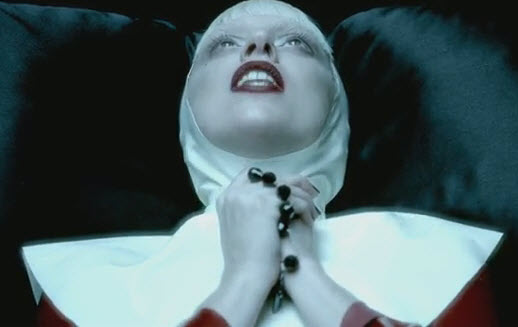
In a later scene, Gaga is shown laying down, wearing a red latex nun suit and holding a rosary.


Looking at the sky she says: “Stop, please, just let me go.” Then, just when she says “Alejandro,” she raises her hands to  the sky. In this context, it is safe to say that Alejandro might very well be God.
“She hides true love
En su bolsillo.
She’s got a halo ’round her finger,
Around you.”

The halo around the finger is a wedding ring and Alejandro has a halo around him, which signifies he is considered “holy.” The wedding ring represents Gaga’s union with God through religion, but she is now ashamed of this marriage. She hides the ring in her bolsillo, the Spanish word for pocket. Why does she refer to a Fernando and a Roberto at some point? Is she referring to the triple aspect of God, the holy Trinity?
The concept of rejection is thus applied to God as he does not seem to satisfy Gaga’s spiritual needs. She then decides to seek godhood herself by embracing a new type of spirituality. It seems to me the nun becomes a Luciferian priestess.

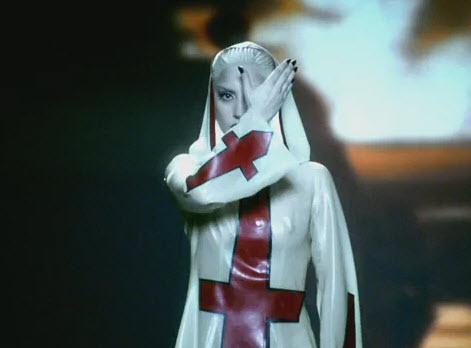
Luciferian priestess hiding one eye as a sign of Illuminati control or loyalty
Inverted Cross
Gaga’s robe contains many inverted crosses. This is extremely significant in symbolic language. The cross is a symbol of the Christian faith as it represents Jesus Christ’s sacrifice and resurrection. In Christianity, the inverted cross is known as the “Cross of St. Peter”, in honor of Simon Peter who requested to be crucified upside down because he felt unworthy to be put to death in the same matter as Christ.
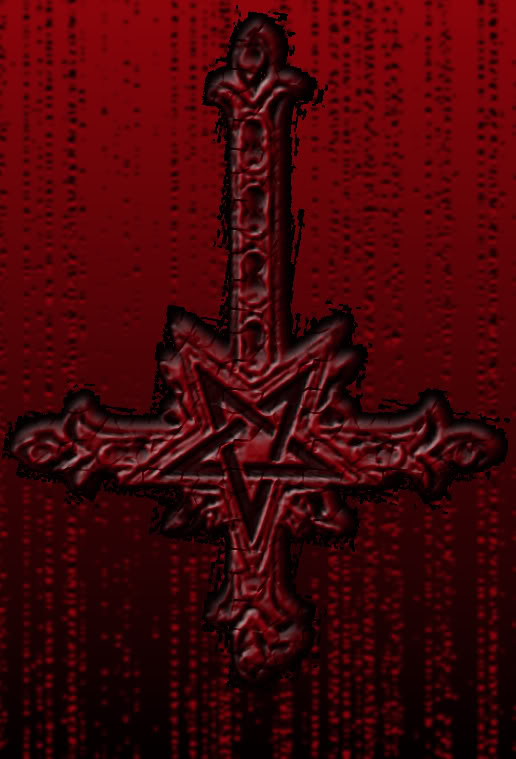
In non-Christian circles, however, the inversion of the cross represents the perversion and desecration of what it symbolizes. For this reason, inverted symbols are found in black magic and satanism.
“In symbolism, an inverted figure always signifies a perverted power (…) Black magic is not a fundamental art; it is the misuse of an art. Therefore it has no symbols of its own. It merely takes the emblematic figures of white magic, and by inverting and reversing them signifies that it is left-handed.”
- Manly P. Hall, Secret Teachings Of All Ages

Inverted cross and inverted pentagram as satanic symbols
The inverted cross, placed on Gaga’s crotch, becomes a phallic symbol. Superimposed and combined with her female genitals, the theme of androgyny becomes prevalent. In occult circles, the alchemical transformation of the spiritual matter, the Great Work, must unite both opposing energies.

Becoming a God


The rosary is a set of beads used in Catholic tradition for prayer and meditation. By swallowing the rosary, Gaga incorporates within her a symbol of religious devotion because 1) it is shocking and would get media attention 2) represents Gaga seeking to obtain godhood by her own means. We have here a symbolic representation of the tenets of Luciferianism, which is the drive to attain divinity by one own means. Lucifer is considered to be the active principle towards godhood, the one who brought “divine light” to the humans.

In another scene, Gaga is shown giving the sign of benediction and blessing, a gesture reserved in Catholicism to those who are considered Holy.

A classic image of Christ showing the sign of Benediction and pointing towards the Sacred Heart
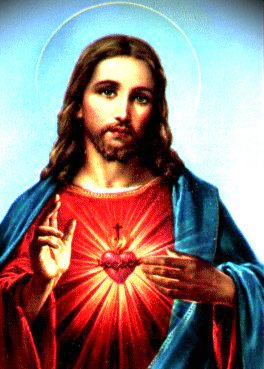
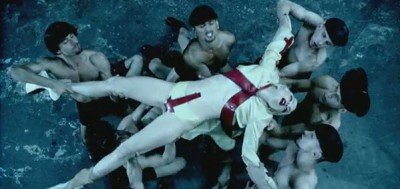
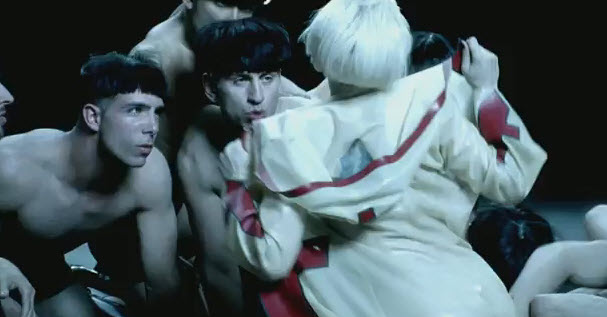
Later in the video, Gaga is violently pushed around and abused by the dancers surrounding her. She surrenders and removes her robe for sexual, ritual initiation.

At the ending of the video, Gaga is consumed from within and her “inner light” comes out, representing her transformation from the physical to the spiritual plane.
Gaga’s performance at American Idol truly exploited the Luciferian theme of the song.

The performance takes place in a setting reminiscent to the Garden of Eden, where the “Fallen Angel”–Lucifer, the one who was banished from Heaven and tempted Adam and Eve with divine knowledge–presides over the ceremony. Fire comes out of the angel’s wings (after all, he is the “Light Bringer”) each time Gaga says “Alejandro.” At the end of the performance, Gaga is lifted up under the Fallen Angel as a blood-red liquid oozes out from the fountain underneath him. Another ritual sacrifice has taken place on prime-time television.

Police State Imagery

Gaga’s spiritual transformation is taking place in a dark, oppressive and militaristic backdrop.During the entire video, we see in the background a giant screen displaying scenes of social unrest, buildings on fire and military police running around, placing the viewers in a tense and oppressive ambiance.

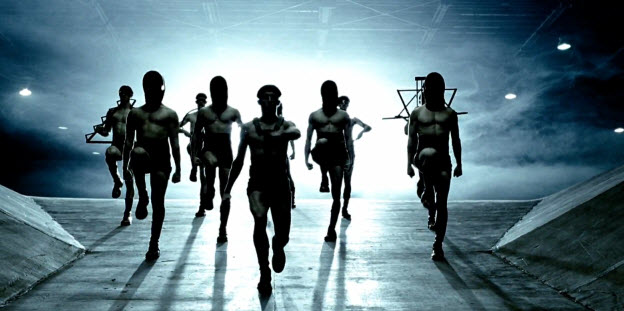
The video opens with men marching to a militaristic rhythm, some of them having their heads covered, maybe hinting that those men are prisoners of some sort. One of the men is inside a pyramidal shape while another holds a hexagram as the prisoners march. Is this a representation of the masses marching to the rhythm of the elite, holding up high the symbols of its own oppression?
Gaga is then shown in a position of power, wearing a black, illuminated crown while looking over the prisoners performing for her.

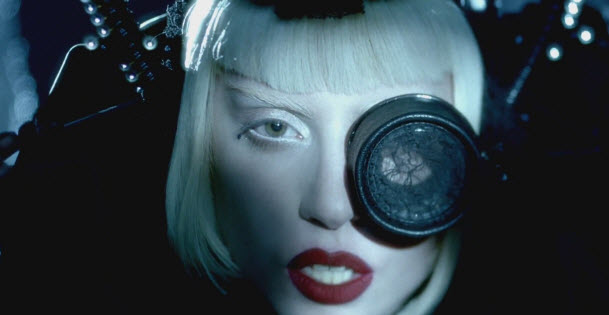
The “Black Queen” removes one goggle at a time, flashing the Illuminati All-Seeing Eye sign and revealing the true nature of her power.

Again, One-Eye hinting to the nature of the oppressive force
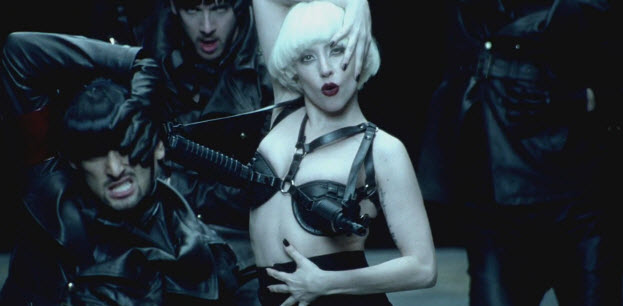
In this scene, Gaga wears a “gun bra,” in accordance with the agenda of the sexualization of oppressive imagery. Her back-up dancers are dressed in uniforms reminiscent of dictatorships of the era of Hitler, Stalin, Franco and Mussolini. Political oppression is indeed sexy … oh wait, no, it’s not … it actually goes against everything Democracy supposedly stands for.

Mind Controlled Slaves?


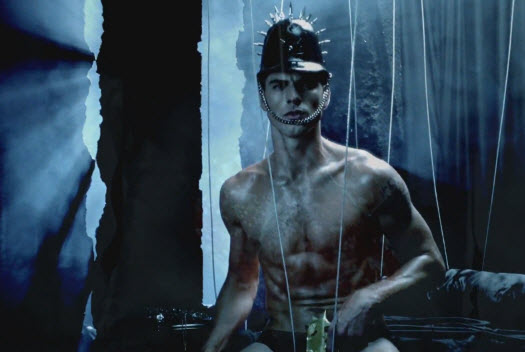
In a symbolic scene,  a soldier is shown attached to strings, like marionette. He is not in control of his own movements and holds a gun on his privates (more sexualization of weaponry). He stares blankly, looking confused as a mind-control slave would.

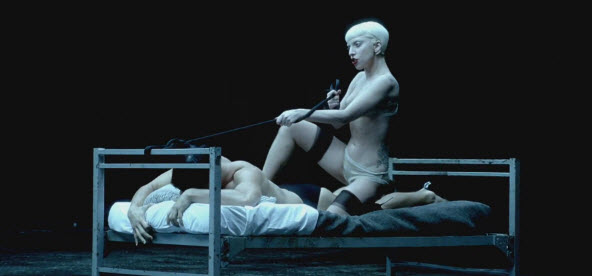
In what looks like an internment camp, Gaga has the gay men bound to a bed as she rapes them, in what looks like a reenactment of ritual abuse.
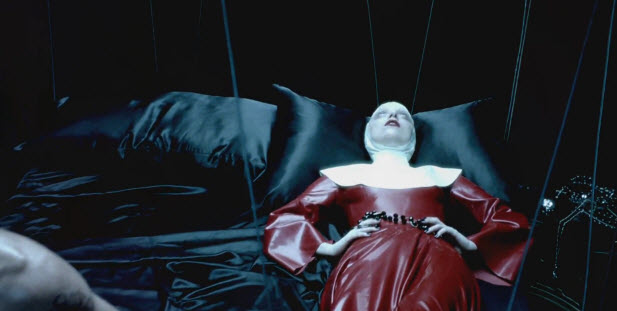
In the final scene of the video, Gaga is shown attached to strings. Is she herself controlled into perpetuating this agenda?
In Conclusion

As stated above, the video to Alejandro is very complex and symbolic, and lends itself to multiple interpretations, depending on the viewer’s knowledge and point of view. There are, however, parts of the video in which the symbolism is clear and concise, leaving little doubt regarding the message being communicated. During the video, Gaga goes through a very profound metamorphosis, rejecting Christian faith by desecrating its symbols and embracing a new type of spirituality.
Is Gaga’s transformation a representation of the transformation that is currently happening on a worldwide scale?
Whatever the case may be, pivotal videos such as this one disseminate into the collective unconscious a specific set of symbols and values that will become, in time, “part of our culture.” In order to achieve this, charismatic figures that are admired by the public are used to make those messages cool and trendy. Music fans have been subjected to an intense creative drought in the past years, which caused them to be desperate for a new, eccentric and iconic presence. So Lady Gaga comes into the picture, slightly distances herself from the painfully formulaic music acts and is heralded as the new pop princess. I’m sure many fans have a gut feeling that something is wrong with her act, but still can’t stop listening to her. They must tell themselves, “well, there is nothing else to listen to.” And that’s what media monopolies are all about. Thank God for the internet.
(c) Outspoken Poet


In 2008, a song called “On Top of the World,” featured three artists: T.I., Ludacris and a little-known southern rapper by the name of B.o.B.
Sandwiched between the inspiring verses of two well-established hip-hop artists, the splendidly-sung chorus became nothing but an afterthought.

Two years and a smash single later, that little-known southern artist has evolved into one of the most promising young musicians in recent memory.
With six mix tapes and two EPs under his belt already, Bobby Ray Simmons – aka “B.o.B” – isn’t exactly the “little-known southern artist” he once was in ’08.

Not that that’s a bad thing.
On April 27, the man behind “Nothin’ On You” released his much-anticipated, first studio LP, The Adventures of Bobby Ray.

Although the album has only 12 songs in all, it is the quintessential example of quality over quantity.
Mellow, acoustics-driven ballads like “Don’t Let Me Fall” and “Lovelier Than You,” as well as “Ghost in a Machine,” not only highlight B.o.B’s unique songwriting, they put his mastery of the guitar on display for all to hear.

More uptempo tracks like “The Kids,” “Fame” and “Magic” are sure to find mainstream success in the coming months. Those songs, along with the Lupe Fiasco-assisted “Past My Shades,” beautifully capture the wit and silky-smooth delivery that made B.o.B an underground success (“Always in detention for the lack of my attention/you can call it deficit/really I just didn’t listen” – “The Kids”).

The production, songwriting, delivery and overall impact of “Airplanes Part II” make it, without question, the album’s crown jewel.Eminem and Hayley Williams (from Paramore) both bless the 12th and final track with their respective gifts: Eminem with an emotional verse chronicling the journey of a budding hip-hop artist whose indecision inevitably keeps him from becoming a star, and Williams with a perfectly-sung chorus.

It's almost a wonder that in todays moraly stripped media, that looks more and more like a mechanised production line that makes vast quantities of identical products, an artist striving for quality has emerged to prominence. And for a hip-hop idealist like me this is a cause for celebration because despite a few ideological strays B.O.B.'s lyrical and musical style is hip-hop and  will take its place in the library of hip-hop culture.

Funny how things always seem to come full circle.

Christina Aguilera’s new album and video introduces fans to a definite style change. The singer now clearly fits the mold of the occult music industry by  incorporating its themes and symbolism into her art. We will look at the hidden meaning of her video “Not Myself Tonight” to and we’ll see how her new album relates with the rest of the music industry.


I’ve always considered Christina Aguilera to be a notch above most pop singers due to the fact that she could actually sing. However,  in order to continue with her success, it was only a matter of time before she ended up in the same place as the other pop stars in the market today. Everything about her new album is heavily tainted with the Illuminati agenda, and the first single Not Myself Tonight acts as an initiation piece. We will see that this plagiarism is, in fact, Christina only following the trend forced on pop stars.
Warning: Parts of this article might be disturbing for some.

From Christina to Xtina

Christina was first discovered by Disney, a company that has specialized in recruiting kids who then progressively become sex bombs as the years go by (Miley Cyrus is next).  Christina was part of a particularly prolific edition of the Mickey Mouse Club.
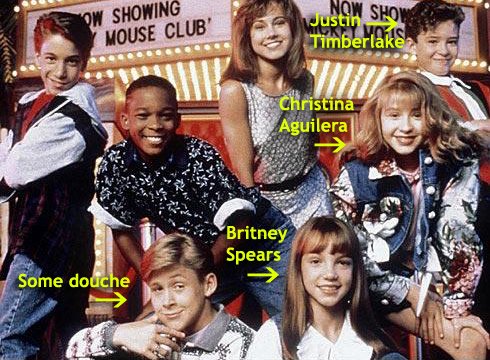
Christina used her great talent to make her way into the pop scene with the 1999 album Christina Aguilera, with a clean “innocent teen” look. Everything changed in 2002-2003 with the release of the album Stripped. In a very symbolic performance during the 2003 MTV Video Music Awards, Christina is “consecrated” by the Kabbalistic Grand Priestess Madonna. This highly publicized event deserves a second look.

2003 VMA Perfomance

Taking place on a Masonic checkerboard-patterned floor, this symbolic performance is the ritualistic initiation of Britney Spears and Christina Aguilera into the occult music business. The ceremony starts with Britney and Christina making their way down a pyramid-shaped cake singing Madonna’s Like a Virgin. The song choice is very significant as it describes the young singers’ purity and innocence before the ceremony. This is also reinforced by their white gowns. Then the Priestess comes out, wearing a black tuxedo and a Masonic top hat.

She sings Hollywood, a song about the city symbolizing the entertainment establishment, the gateway to super-stardom, as she walks down the 13 steps of initiation. Madonna is a representative of the occult industry and welcomes Britney and Christina into it. She sings:
Everybody comes to Hollywood
They wanna make it in the neighborhood
They like the smell of it in Hollywood
How could it hurt you when it looks so good?
Shine your light now
This time it’s got to be good
You get it right now
Cause you’re in Hollywood

The entire performance puts into light Madonna’s domination and superiority over the singers. She ultimately passes on the torch to the two singers with a symbolic kiss.
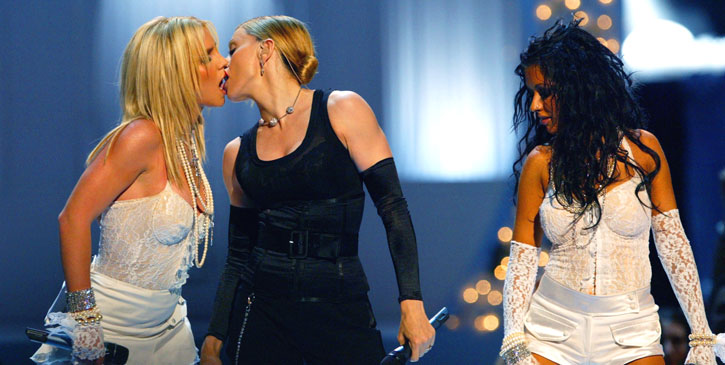
Following in the footsteps of Madonna, Christina and Britney then appeared to dabble with Kabbalah, though only a “Hollywood” brand of Kabbalah, as tattoos are not permitted in its sacred scriptures.


Left is Britney’s tattoo of the Hebrew letters Mem-Hey-Shin, one of the 72 names of God. This one represents “healing”. Right is Christina’s tattoo of the Hebrew characters Yud and Bet, apparently dedicated to her husband Jordan Bratman.
In the years that followed, Christina took the apparently obligatory “sexualization” path of Illuminati idols and also appeared in works associated with black magic and mind control.

New Christina


Black magic photo shoot complete with ritualistic pentagram and discarded dolls



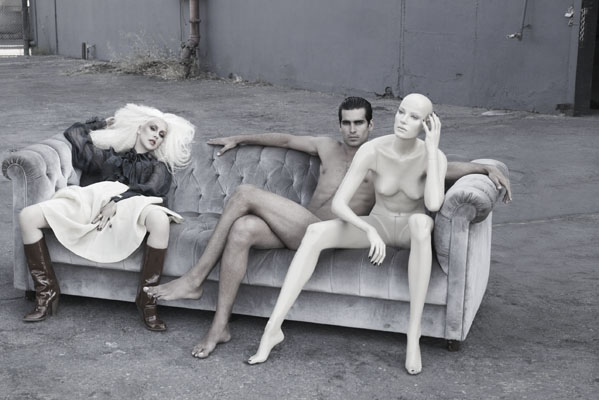
Dehumanization and alter persona symbolized by the mannequin
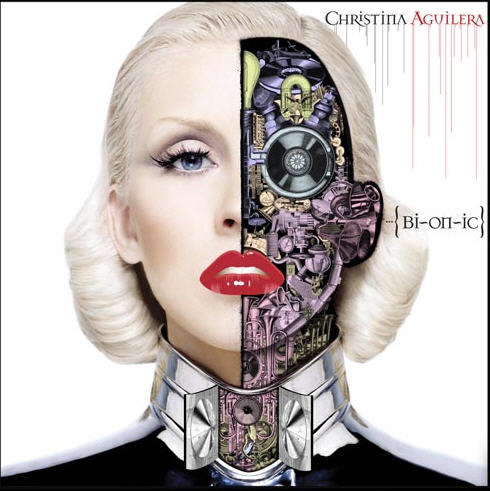
Her latest effort completely embraces today’s Illuminati agenda by exploiting the theme of transhumanism. The album title “Bionic” and the cover art is truly about the merger of man and robot. Christina’s head is portrayed as a programmable mechanism, a concept relating to mind control.


Christina as a programmable robot (reference to mind control) and the now inevitable focus on one eye
More One Eye Symbolism

As seen in many other articles, almost all pop artists taking on Illuminati themes in their art almost always flash the “one eye sign” in their videos or photo shoots. Christina is not an exception.
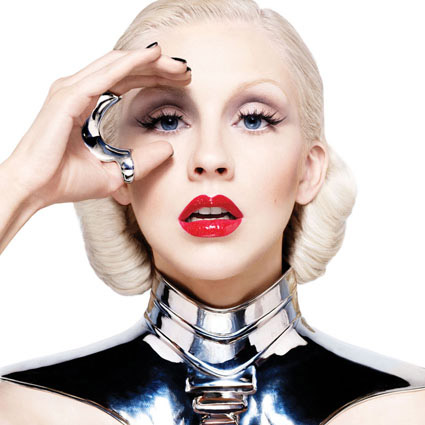
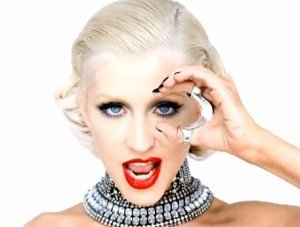


Concept of Not Myself Tonight

 The Video
http://www.youtube.com/watch?v=TjoqHasrjIQ 
Not Myself Tonight has been accused of copying Lady Gaga’s Bad Romance. Although the videos were produced by two different directors (Francis Lawrence for Gaga and Hype Williams for Christina), they both exploit similar themes, which are also common in many other pop music videos. Although it is easy to say “the bitch copied Gaga!”, this statement does not take into consideration the bigger picture of the music industry. The same themes are expected and required to be prevalent in today’s hits. The industry defines its own trends and in order to be successful, artists must follow these trends and communicate the same messages. Not Myself Tonight is simply a continuation through another artist, and therefore exploits trademark themes such as mind control, transhumanism, occult initiation and so forth.

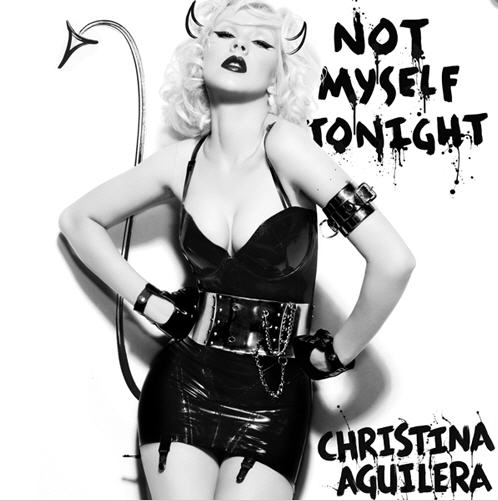
The subject of the song is Christina being “not herself tonight” which is, at face value, her wanting to go out and go crazy, “kissing the boys and the girls.” However, the imagery and symbolism of the video adds another level of interpretation to the song that refers to mind control, occult initiation and alter personalities. The theme of being “out of character” and not controlling one’s actions is often portrayed in recent videos and is associated, through symbolism, to Monarch programming or supernatural “possession.” This is often symbolically represented by the classic “devil horns” as seen on the promo image of her single.


As said earlier, she is just following the trend set by the industry.

Monarch programming is a mind-control method based on the creation of an alternate persona through the usage of torture and ritual abuse. Some authors on the subject, such as Ron Patton, have mentioned that Monarch programming utilizes ancient occult techniques reminiscent of spirit possession. The lyrics of the song reflect the creation of a new persona:
“I’m out of character, I’m in rare form
And if you really knew me, you’d know its not the norm

Cos I’m doing things that I normally won’t do
The old me is gone
, I feel brand new
And if you don’t like it, fuck you”

As we will see later, the symbolism of the video is based on initiation and on the creation of an alter personality, which is expressed lyrically The old me is gone, I feel brand new. The theme of being a crazier/wilder/sexier self is often portrayed in recent videos and is almost always coupled with scenes of restraint, dehumanization and/or torture. This is an obvious case of cognitive dissonance, where the portrayal of torture is a part of one’s “liberation.” In Not Myself Tonight, Christina is seen hog-tied with her eyes forced opened, which is reminiscent of mind control victims being forced to watch videos to reinforce their programming.
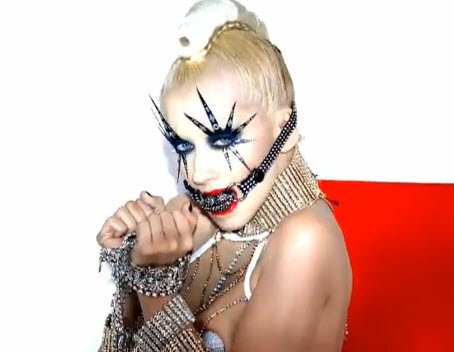
This practice is depicted in the mind-control themed Clockwork Orange by Stanley Kubrick.


Screen shot from Clockwork Orange where Alex is forced to watch ultra-violent scenes as part of his reprogramming.

Sex Kitten Programming

The first part of the video is heavily tainted with references to mind control and, more precisely, Sex Kitten programming. This trend is becoming increasingly common in the music and fashion industry.
BETA. Referred to as “sexual” programming. This programming eliminates all learned moral convictions and stimulates the primitive sexual instinct, devoid of inhibitions. “Cat” alters may come out at this level.
-Ron Patton, Project Monarch
In mind control, Beta programming, also known as Sex Kitten programming creates in the dissociative victim an alter-personality that is a programmed to be sex slave.
“The mind will begin to dissociate, and will begin to reverse the primordial brain functions such as pain is pleasure. The person’s mind rearranges. This is often done with Beta alters or Beta models to get them to think that the pain of sadistic rape is a pleasure. After this reversal in the mind that “PAIN IS LOVE”, the S&M kitten alters will beg their handler to slap them, tie them up, hurt them, etc.”
- Cisco Wheeler and Fritz Springmeier, The Illuminati Formula Used to Create an Undetectable Total Mind Controlled Slave
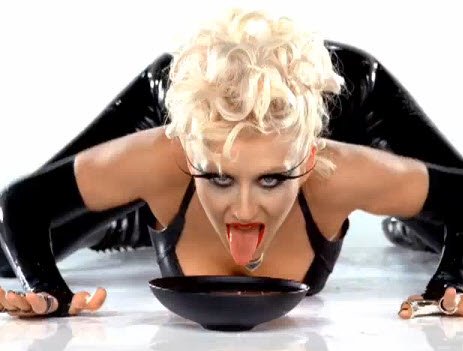
Some references to sex kitten programming are peppered throughout the video.

The creation of alter personalities is represented in the video with Christina being surrounded by  look-a-likes. She plays the role of the mind-control handler herself.
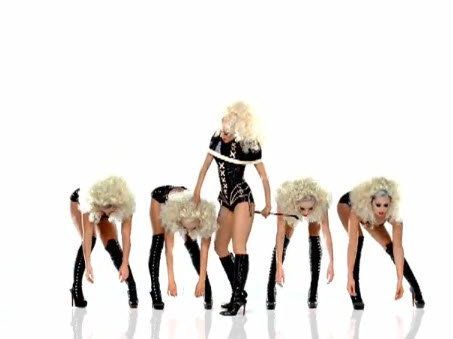


Ritual Initiation

The second part of the video essentially describes Xtina’s “initiation” through ritual sex. Some symbolic scenes tell this story.
Halfway through the song, Christina is dressed in black with masculine features and standing between two pseudo-masonic pillars.
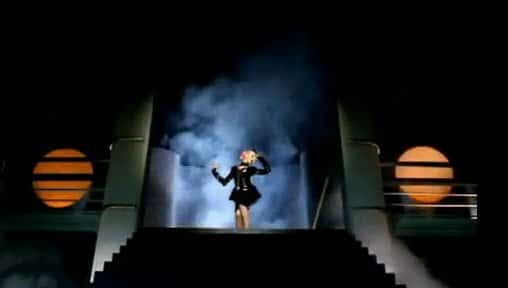
This scene is similar to the VMA performance referenced above, where Madonna played the master of ceremonies. Christina plays the same role in this scene. She is standing on top of stairs, near a mysterious gateway, symbolizing her high rank within the “inner-hierarchy”. Her monocle covers one eye which refers to the Illuminati power structure. The master of ceremonies kicks off the ritual initiation of Xtina, the Sex Kitten.
In the following scene, Xtina is shown entering a doorway, symbolizing the “passing through the gates” of her initiation.
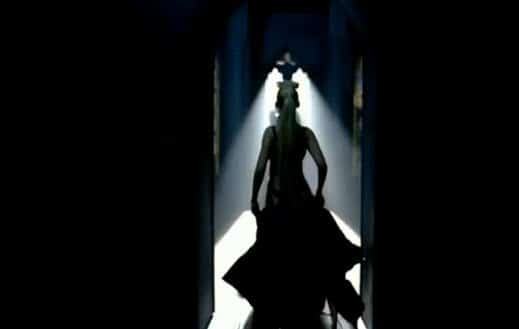
Xtina is then shown putting fire to her clothes, indicating that she is destroying her old self and embracing the new Xtina alter persona.

The initiation is then sealed and consummated by nothing less than an orgy inside a church.
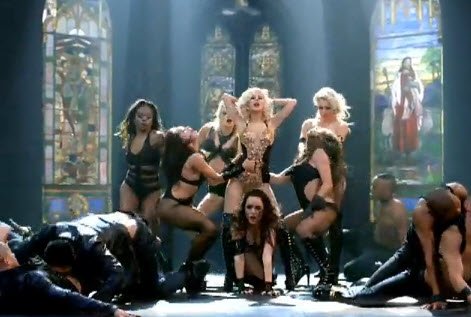


The scene in the church gives spiritual connotation to the initiation. An orgy in a place that is considered sacred is a form of desecration that  is reminiscent of black magic rituals. The video is not simply about a girl wanting to “go crazy,” it is about an initiation into the “dark side.”

In Conclusion

Although Christina Aguilera’s new work was accused of plagiarism by some pop culture observers, they fail to realize that she is simply following the agenda forced on pop stars. The standardization of the music industry has resulted in different artists exploiting the same symbolism, themes and aesthetics. Superficial differences define each artist, but the content and message of their music stay the same.This repetition is an important clue to identify the existence of a alternative agenda in the industry.
The complete transformation of Christina Aguilera for the Bionic album, and her embrace of ALL of the themes discussed in previous articles (including the “one-eye thing”) should send you a clear message. There is an agenda in the music industry and one must fit the mold in order to get promoted as a star. This does not guarantee worldwide success, but it is the only way to get the industry approval needed to obtain it.

Blogger Template by Blogcrowds