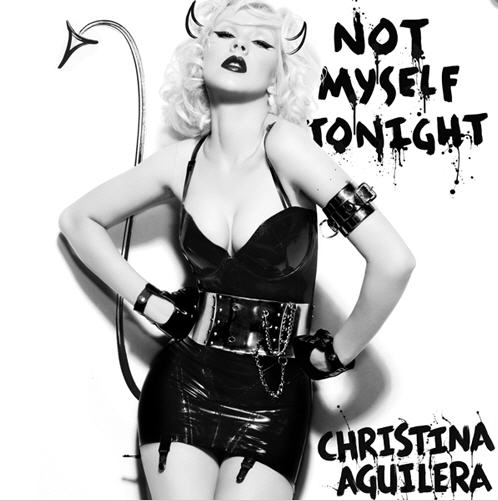
Christina Aguilera’s “Not Myself Tonight”: More Illuminati Music
0 comments Posted by in.SIGHT at 05:01 Christina Aguilera’s new album and video introduces fans to a definite style change. The singer now clearly fits the mold of the occult music industry by incorporating its themes and symbolism into her art. We will look at the hidden meaning of her video “Not Myself Tonight” to and we’ll see how her new album relates with the rest of the music industry.
I’ve always considered Christina Aguilera to be a notch above most pop singers due to the fact that she could actually sing. However, in order to continue with her success, it was only a matter of time before she ended up in the same place as the other pop stars in the market today. Everything about her new album is heavily tainted with the Illuminati agenda, and the first single Not Myself Tonight acts as an initiation piece. We will see that this plagiarism is, in fact, Christina only following the trend forced on pop stars.
Warning: Parts of this article might be disturbing for some.

From Christina to Xtina
Christina was first discovered by Disney, a company that has specialized in recruiting kids who then progressively become sex bombs as the years go by (Miley Cyrus is next). Christina was part of a particularly prolific edition of the Mickey Mouse Club.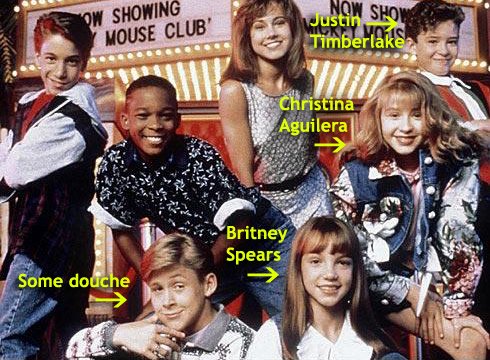
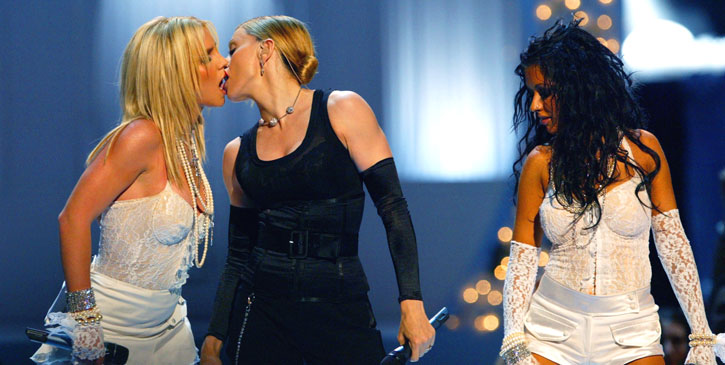
Christina used her great talent to make her way into the pop scene with the 1999 album Christina Aguilera, with a clean “innocent teen” look. Everything changed in 2002-2003 with the release of the album Stripped. In a very symbolic performance during the 2003 MTV Video Music Awards, Christina is “consecrated” by the Kabbalistic Grand Priestess Madonna. This highly publicized event deserves a second look.
2003 VMA Perfomance
Taking place on a Masonic checkerboard-patterned floor, this symbolic performance is the ritualistic initiation of Britney Spears and Christina Aguilera into the occult music business. The ceremony starts with Britney and Christina making their way down a pyramid-shaped cake singing Madonna’s Like a Virgin. The song choice is very significant as it describes the young singers’ purity and innocence before the ceremony. This is also reinforced by their white gowns. Then the Priestess comes out, wearing a black tuxedo and a Masonic top hat.
She sings Hollywood, a song about the city symbolizing the entertainment establishment, the gateway to super-stardom, as she walks down the 13 steps of initiation. Madonna is a representative of the occult industry and welcomes Britney and Christina into it. She sings:
Everybody comes to Hollywood
They wanna make it in the neighborhood
They like the smell of it in Hollywood
How could it hurt you when it looks so good?
Shine your light now
This time it’s got to be good
You get it right now
Cause you’re in Hollywood
The entire performance puts into light Madonna’s domination and superiority over the singers. She ultimately passes on the torch to the two singers with a symbolic kiss.
Following in the footsteps of Madonna, Christina and Britney then appeared to dabble with Kabbalah, though only a “Hollywood” brand of Kabbalah, as tattoos are not permitted in its sacred scriptures.

- Left is Britney’s tattoo of the Hebrew letters Mem-Hey-Shin, one of the 72 names of God. This one represents “healing”. Right is Christina’s tattoo of the Hebrew characters Yud and Bet, apparently dedicated to her husband Jordan Bratman.
In the years that followed, Christina took the apparently obligatory “sexualization” path of Illuminati idols and also appeared in works associated with black magic and mind control.
New Christina

- Black magic photo shoot complete with ritualistic pentagram and discarded dolls


- Dehumanization and alter persona symbolized by the mannequin
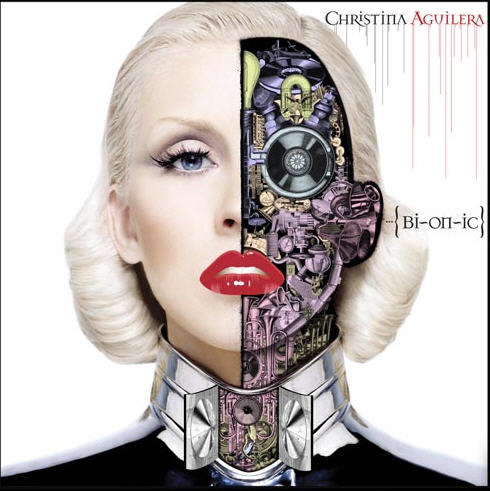
Her latest effort completely embraces today’s Illuminati agenda by exploiting the theme of transhumanism. The album title “Bionic” and the cover art is truly about the merger of man and robot. Christina’s head is portrayed as a programmable mechanism, a concept relating to mind control.

- Christina as a programmable robot (reference to mind control) and the now inevitable focus on one eye
More One Eye Symbolism
As seen in many other articles, almost all pop artists taking on Illuminati themes in their art almost always flash the “one eye sign” in their videos or photo shoots. Christina is not an exception.



Concept of Not Myself Tonight
The Videohttp://www.youtube.com/watch?v=TjoqHasrjIQ
Not Myself Tonight has been accused of copying Lady Gaga’s Bad Romance. Although the videos were produced by two different directors (Francis Lawrence for Gaga and Hype Williams for Christina), they both exploit similar themes, which are also common in many other pop music videos. Although it is easy to say “the bitch copied Gaga!”, this statement does not take into consideration the bigger picture of the music industry. The same themes are expected and required to be prevalent in today’s hits. The industry defines its own trends and in order to be successful, artists must follow these trends and communicate the same messages. Not Myself Tonight is simply a continuation through another artist, and therefore exploits trademark themes such as mind control, transhumanism, occult initiation and so forth.
The subject of the song is Christina being “not herself tonight” which is, at face value, her wanting to go out and go crazy, “kissing the boys and the girls.” However, the imagery and symbolism of the video adds another level of interpretation to the song that refers to mind control, occult initiation and alter personalities. The theme of being “out of character” and not controlling one’s actions is often portrayed in recent videos and is associated, through symbolism, to Monarch programming or supernatural “possession.” This is often symbolically represented by the classic “devil horns” as seen on the promo image of her single.
As said earlier, she is just following the trend set by the industry.

Monarch programming is a mind-control method based on the creation of an alternate persona through the usage of torture and ritual abuse. Some authors on the subject, such as Ron Patton, have mentioned that Monarch programming utilizes ancient occult techniques reminiscent of spirit possession. The lyrics of the song reflect the creation of a new persona:
“I’m out of character, I’m in rare form
And if you really knew me, you’d know its not the norm
Cos I’m doing things that I normally won’t do
The old me is gone , I feel brand new
And if you don’t like it, fuck you”
As we will see later, the symbolism of the video is based on initiation and on the creation of an alter personality, which is expressed lyrically The old me is gone, I feel brand new. The theme of being a crazier/wilder/sexier self is often portrayed in recent videos and is almost always coupled with scenes of restraint, dehumanization and/or torture. This is an obvious case of cognitive dissonance, where the portrayal of torture is a part of one’s “liberation.” In Not Myself Tonight, Christina is seen hog-tied with her eyes forced opened, which is reminiscent of mind control victims being forced to watch videos to reinforce their programming.

This practice is depicted in the mind-control themed Clockwork Orange by Stanley Kubrick.

- Screen shot from Clockwork Orange where Alex is forced to watch ultra-violent scenes as part of his reprogramming.

Sex Kitten Programming
The first part of the video is heavily tainted with references to mind control and, more precisely, Sex Kitten programming. This trend is becoming increasingly common in the music and fashion industry.BETA. Referred to as “sexual” programming. This programming eliminates all learned moral convictions and stimulates the primitive sexual instinct, devoid of inhibitions. “Cat” alters may come out at this level.In mind control, Beta programming, also known as Sex Kitten programming creates in the dissociative victim an alter-personality that is a programmed to be sex slave.
-Ron Patton, Project Monarch
“The mind will begin to dissociate, and will begin to reverse the primordial brain functions such as pain is pleasure. The person’s mind rearranges. This is often done with Beta alters or Beta models to get them to think that the pain of sadistic rape is a pleasure. After this reversal in the mind that “PAIN IS LOVE”, the S&M kitten alters will beg their handler to slap them, tie them up, hurt them, etc.”Some references to sex kitten programming are peppered throughout the video.
- Cisco Wheeler and Fritz Springmeier, The Illuminati Formula Used to Create an Undetectable Total Mind Controlled Slave

The creation of alter personalities is represented in the video with Christina being surrounded by look-a-likes. She plays the role of the mind-control handler herself.

Ritual Initiation
The second part of the video essentially describes Xtina’s “initiation” through ritual sex. Some symbolic scenes tell this story.Halfway through the song, Christina is dressed in black with masculine features and standing between two pseudo-masonic pillars.
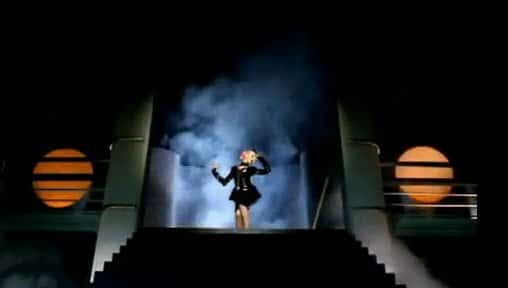
This scene is similar to the VMA performance referenced above, where Madonna played the master of ceremonies. Christina plays the same role in this scene. She is standing on top of stairs, near a mysterious gateway, symbolizing her high rank within the “inner-hierarchy”. Her monocle covers one eye which refers to the Illuminati power structure. The master of ceremonies kicks off the ritual initiation of Xtina, the Sex Kitten.
In the following scene, Xtina is shown entering a doorway, symbolizing the “passing through the gates” of her initiation.
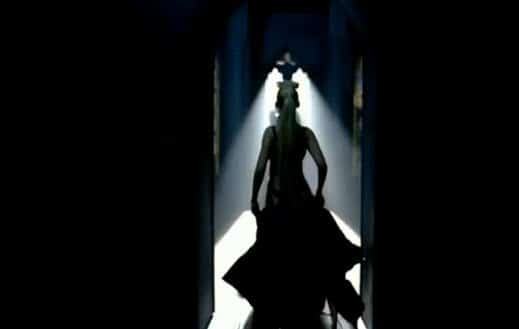 Xtina is then shown putting fire to her clothes, indicating that she is destroying her old self and embracing the new Xtina alter persona.
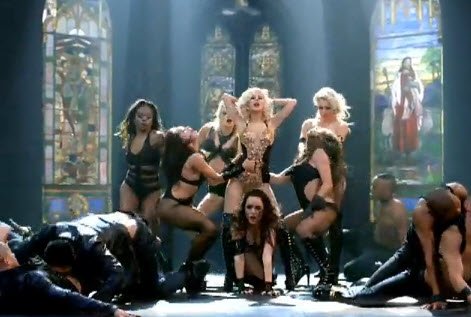
The initiation is then sealed and consummated by nothing less than an orgy inside a church.
In Conclusion
Although Christina Aguilera’s new work was accused of plagiarism by some pop culture observers, they fail to realize that she is simply following the agenda forced on pop stars. The standardization of the music industry has resulted in different artists exploiting the same symbolism, themes and aesthetics. Superficial differences define each artist, but the content and message of their music stay the same.This repetition is an important clue to identify the existence of a alternative agenda in the industry.The complete transformation of Christina Aguilera for the Bionic album, and her embrace of ALL of the themes discussed in previous articles (including the “one-eye thing”) should send you a clear message. There is an agenda in the music industry and one must fit the mold in order to get promoted as a star. This does not guarantee worldwide success, but it is the only way to get the industry approval needed to obtain it.



Imagine we are foreign intelligence service agents and we spy for Russian military bases. Just a few years ago it was impossible, not to mention how it was impossible during the iron curtain era. But now thanks to google we can see all the top secret Russian objects clearly on those shots.
Russia still stays very militarized country.
If to explore with Google earth just a small part of it, the Murmansk region (one of many of Russian regions) which is located next to Norway and Finland, we can meet tens of military objects, mainly Russian Navy ones.
Here they are:
All the locations on these shots as have been said are from Murmansk region.
This one is Olenegorsk, Russian air force base. Those are not just fighters, those are strategic bombers.
Murmansk itself, abandoned navy ships.
Murmansk. Nuclear-powered ice-breaker in the dock.
Kola Bay, near Murmansk, small town “Poliarniy”, oil-tanker “Belokamenka”. One of the largest oil tankers in the world. It is 100 feet tall (as ten stores building).
It is more than 1000 ft long (340 metres), width 200 ft (65 metres), it transports 4 millions tons of oil each year.
Severomorsk. Ships of Russian Northern Navy. The sixth from the left is the biggest ship in the Russian Northern Navy - nuclear-powered cruiser “Kirov”.
Russian submarines.
Different types of Russian submarines.
Russian S-300 (SA-10) long range surface-to-air missiles. The same ones as Russia now exports to Iran. We had a few months ago an article about an inflatable version of those missiles - the ones that can fool the from-air observer.
Another abandoned ship near Murmansk.
More Russian submarines. It is the home base of legendary “Kursk” submarine, the one which got sank a few years ago near Murmansk and whole crew died, because the rescue team has not come in time. Take a not on the submarine to the right - it is split to two parts, probably this is a bug of google photos.
And even more abandoned Russian Navy ships.
Some unidentified Navy object a few miles from the shore.
All the submarines we have seen before were children toys in comparisson with those. Those are sisters of the already mentioned “Kursk” submarine. 500 ft long, 60 ft high. They say it can sweep major USA cities of the ground.
Those are previously top-secret “Taifun” class submarines. The biggest nuclear-powered submarines in the world. They could carry up to 200 missiles.
Here are them from a more distant perspective. “Taifuns” from the left and “949A” (”Kursk sisters”) from the left.
This is the storage for a used nuclear fuel.
Gremiha. Empty nuclear missiles wells.
Gremiha. Under this cape there is another underground submarine base and from these road two tunnels lead inside.
Kovdor. A hidden mountain.
Allakurti. Military base.
Allakurti, same military base.


It is always sad when great men pass away, and this is such a case indeed. Highly underappreciated, maybe now Gang Star’s legacy will be observed and analysed closely for what it really is. R.I.P. Guru.
Twenty years ago this fall, as the Orioles triumphed in the World Series, baby boomers flocked to The Big Chill and radios played Michael Jackson's Thriller, the superpowers drifted obliviously to the brink of nuclear war.
That is the disturbing conclusion of a number of historians who have studied the bellicose rhetoric and mutual incomprehension of the United States and the Soviet Union, which then had more than 20,000 nuclear warheads between them. With the possible exception of the Cuban Missile Crisis in 1962, they say, the autumn of 1983 might have been the most dangerous moment in the history of the Cold War.
Ailing Soviet leader Yuri V. Andropov, urged on by Soviet hard-liners and acutely aware that his country was losing the military technology race, had become increasingly worried that the Americans might be planning a nuclear first strike. President Ronald Reagan's rhetoric about the "evil empire" and U.S. military exercises poured fuel on Soviet war paranoia.
A series of mishaps and misunderstandings made conceivable a catastrophe that would have dwarfed today's worst fears of terrorists wielding weapons of mass destruction. That it did not happen is in part thanks to a KGB turncoat who alerted the West to Soviet fears and a Russian duty officer who did not panic when an archaic satellite reported that U.S. missiles were on the way.
"In retrospect, it was a pretty terrifying time," says Benjamin B. Fischer, a 30-year CIA veteran who now works on the agency's historical staff. "We're lucky it ended the way it did."
Fischer, who has published a seminal paper on the period through the CIA's Center for the Study of Intelligence, says the danger resulted when wildly exaggerated fears of a U.S. surprise attack took hold in "the geriatric ward" of the aging Soviet leadership. But a contributing factor was the reluctance of Reagan and his advisers to believe that Russian fears were genuine, he says.
"We don't do Pearl Harbors. So we couldn't believe they really thought we were capable of a first strike," Fischer says.
John Prados, a Cold War historian and senior analyst at the National Security Archive in Washington, calls the fall of 1983 "a moment of high danger, in some respects more dangerous than the Cuban Missile Crisis. Both sides were more heavily armed. Both sides were more hostile."
Yet, by comparison with the Cuban crisis, what historians call the "Soviet war scare" of 1983 remains little known.
"The Cuban Missile Crisis evolved in a very public manner," Prados says. "In 1983, the whole thing happened in secret."
Behind the tensions of 1983 was a program devised in 1981 by then-KGB chief Andropov called Operation RYAN, not a code name but a stark Russian acronym for "nuclear missile attack." Secret orders were issued to KGB officers around the world to look for signs, however subtle, that the United States might be preparing a pre-emptive strike.
KGB officer Oleg A. Gordievsky, who as a British agent later played a key role in the drama, watched RYAN unfold from KGB headquarters in Moscow and then as an intelligence officer posted to London. He saw a gulf between the views of worldly Soviet intelligence officers in the field and the paranoia of Kremlin leaders.
"I never met anyone in the KGB who believed in the possibility of a first nuclear strike by the U.S.," Gordievsky says in an interview from his home in England. "Yet they all reported on the signs of such an attack because they were ordered to do it. They were afraid to say what they really thought."
By 1983, Soviet fears were growing, heightened by the imaginary evidence of a planned surprise attack reported by the Kremlin's cowed spies and by tough talk from Reagan.
In March, Reagan announced the Strategic Defense Initiative, a futuristic missile-defense scheme many American scientists thought technically implausible. Soviet military leaders took the plan far more seriously, worrying that it might eventually make the Soviet nuclear arsenal useless.
That month, Reagan famously stepped up his anti-Soviet rhetoric. Speaking to the National Association of Evangelicals in Orlando, he urged the Christian group in considering nuclear freeze proposals not to "label both sides equally at fault, to ignore the facts of history and the aggressive impulses of an evil empire, to simply call the arms race a giant misunderstanding and thereby remove yourself from the struggle between right and wrong, good and evil."
Meanwhile, NATO plans to deploy Pershing II nuclear missiles in West Germany were seen by the Soviet Union as shortening to a few minutes the warning they might have of a strike. From Moscow, the Pershing deployment created fears like those that shook Washington when U.S. spy planes discovered Soviet missiles in Cuba.
"The danger was in the Soviet leadership thinking, 'the Americans may attack, so we better attack first,' " says Oleg D. Kalugin, a former KGB chief of foreign counterintelligence, who lives outside Washington. While the KGB and military had institutional interests in exaggerating the risk of attack, Andropov's distrust of American leaders was profound, says Kalugin, who knew him well.
But American officials tended to interpret shrill protests from Andropov and his colleagues as empty propaganda. "The Reagan administration was committed to believing its own rhetoric - that SDI didn't threaten the Soviet Union and that the Pershings were not a first-strike weapon," Prados says.
Then came a series of potential sparks. On Sept. 1, 1983, a Soviet fighter shot down a South Korean airliner that had strayed into Soviet airspace, killing the 269 people aboard and prompting angry accusations from both sides.
Next, on Sept. 26, a Soviet satellite misinterpreted sunlight glinting off clouds above a U.S. intercontinental ballistic missile site in Montana as the launch of five ICBMs.
Lt. Col. Stanislav Petrov, the duty officer overseeing the warning system, kept his cool, reasoning that a U.S. first strike would involve hundreds of missiles, not just five. Instead of sounding the alarm, Petrov checked ground radar and other data, and decided that the satellite's alert was false.
Petrov's health was broken by the stress of the incident and its aftermath, and he soon retired from the military. When his actions that day were revealed by a Russian magazine in 1998, reporters found him infirm and surviving on a tiny pension outside Moscow.
Petrov's unsung heroism did not end the danger. A major U.S.-NATO military exercise called Able Archer was planned for November 1983. With emotions still running high on both sides, some Soviet officials feared that the exercise might be a cover for the long-feared nuclear attack.
But by then, Gordievsky had begun to feed to skeptical contacts in British intelligence documents from Operation RYAN showing that Soviet leaders' war fears were genuine.
"There was incredulity at first. The British couldn't believe the Soviet leaders could think like this," recalls Gordievsky. "The Americans were even more disbelieving."
Nonetheless, in part because Gordievsky's warnings were being passed on by British intelligence, the United States scaled back Able Archer, which initially foresaw a role-playing part for Reagan. Tensions gradually eased, though the CIA's Fischer has found the war scare had a second phase in East Germany as late as 1985-1986. By then, Mikhail S. Gorbachev had come to power, quashed the first-strike fears and moved boldly to negotiate an end to the Cold War.
Gordievsky, 64, escaped Russia in 1985 but was sentenced to death in absentia for treason, a penalty never canceled by post-Soviet Russian governments. He says he considers Reagan's defense buildup "brilliant" because it persuaded the Soviet leadership that they could no longer compete and sped the end of the Cold War.
But the strategy was also extremely risky, he says.
"If the Soviet Union had overreacted, it could have gone very badly," he says, adding in a mild understatement: "If war had come, Soviet missiles would have destroyed Britain entirely, at least half of Germany and France and America would have lost maybe 30 percent of its cities and infrastructure."